

Protocol
Overview
rail0 is a single immutable smart contract that implements the full authorize → capture →
refund lifecycle for stablecoin payments. Buyer (payer) and merchant (payee) transact
directly: there is no owner, no admin, no fee and no operator in between, and anyone can deploy
it or call it.

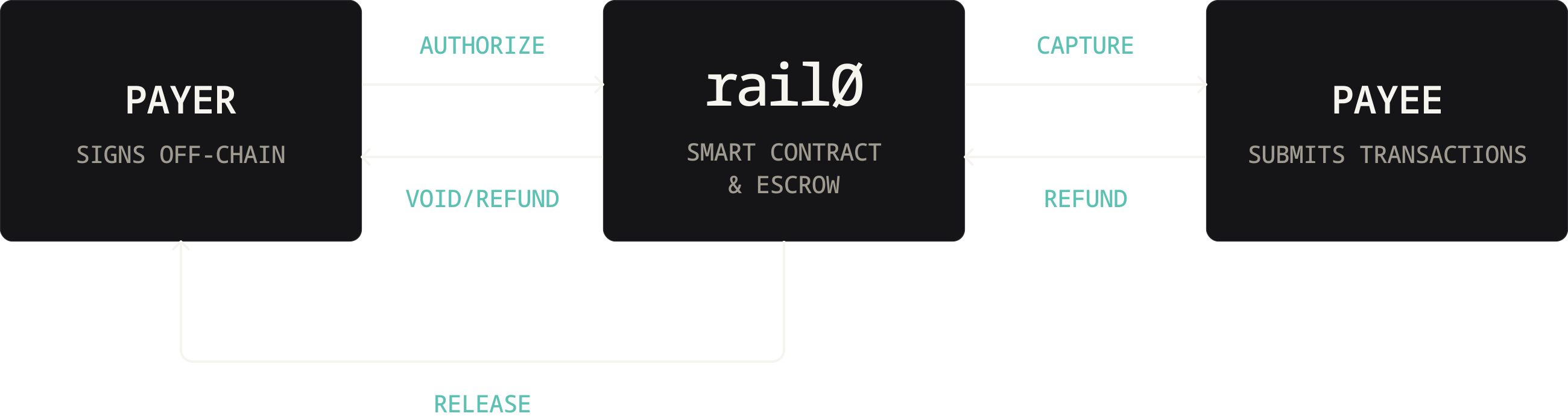

- One signature, no allowance. The buyer signs an EIP-3009
ReceiveWithAuthorizationoff-chain; the merchant submits the transaction and pays gas. With a plain ERC-20, a contract can only move your tokens after you grant it an allowance withapprove: a separate transaction, with its own gas, that leaves a standing permission open. An EIP-3009 signature authorizes one specific transfer and nothing else, so there is no allowance to grant, no setup transaction, and nothing left behind to revoke. - No custody outside the escrow window. The contract holds funds only while a payment is authorized and not yet captured, and routes every captured token to the merchant in full.
- Time-based recourse only. There is no arbitration layer. Funds return to the buyer through
void,releaseafter expiry, or the merchant’srefund.
Two time windows
Section titled “Two time windows”Every payment is defined by terms the buyer and merchant agree on up front, including two deadlines:
- Until
authorizationExpiry, the merchant cancapturethe escrowed funds — partially or in full, across one or more calls — or, while nothing has been captured yet,voidthe hold. - After
authorizationExpiry, either party canreleasewhatever is left in escrow back to the buyer. - Until
refundExpiry, the merchant canrefundany captured amount, and the buyer can raise adispute.
refundExpiry must be at least one day after authorizationExpiry, so every payment keeps a
usable refund window. authorizationExpiry is also the deadline for opening the payment: rail0
pins it as the buyer signature’s validBefore.
Operations
Section titled “Operations”| Operation | Submitted by | When | Effect |
|---|---|---|---|
authorize | payee, with the payer’s signature | before authorizationExpiry | Moves amount from the buyer into escrow. |
charge | payee, with the payer’s signature | before authorizationExpiry | Pays amount straight to the merchant — no hold. |
capture | payee | before authorizationExpiry | Moves escrowed funds to the merchant. Partial captures allowed. |
void | payee | while nothing is captured | Returns the whole escrow to the buyer. |
release | payer or payee | after authorizationExpiry | Returns the remaining escrow to the buyer. |
refund | payee, with its own signature | before refundExpiry | Pulls funds from the merchant’s wallet back to the buyer. |
dispute / closeDispute | payer | dispute before refundExpiry | Raises or withdraws a dispute flag. Moves no funds. |
Every fund-moving operation is submitted by the merchant, except release, which either party
may submit — the funds go to the buyer either way.
The Payment struct
Section titled “The Payment struct”A payment’s terms are committed on its first call and passed, unchanged, on every call after
it. The contract stores only their EIP-712 hash and rejects any call whose struct does not match
(PaymentMismatch).
| Field | Type | Meaning |
|---|---|---|
payer | address | Buyer: source of the funds and signer of the EIP-3009 authorization. |
payee | address | Merchant: submits the operations and receives captured funds. |
token | address | The stablecoin. Must be on the deployment’s allowlist. |
amount | uint120 | Exactly what the buyer commits to pay. |
authorizationExpiry | uint48 | End of the capture window; release opens at this time. |
refundExpiry | uint48 | End of the refund and dispute window. |
Each payment is identified by a caller-chosen bytes32 paymentId. The contract enforces that an
id is never reused, but does not generate it — use a collision-resistant scheme.
Per payment the contract keeps one packed storage slot:
capturableAmount— funds held in escrow.refundableAmount— funds already paid to the merchant that can still be refunded.disputed— the buyer’s dispute flag. It has no effect on funds.
capture moves value from the first bucket to the second; refund drains the second.
Read them with getPaymentState(paymentId).
One signature, bound to the terms
Section titled “One signature, bound to the terms”rail0 introduces no signing format of its own. The buyer signs the token’s standard EIP-3009
ReceiveWithAuthorization, with a nonce rail0 derives from the operation:
authorizeNonce = keccak256(keccak256("RAIL0.AUTHORIZE"), paymentId, configHash)chargeNonce = keccak256(keccak256("RAIL0.CHARGE"), paymentId, configHash)configHash is the payment’s EIP-712 hash, so the nonce binds the signature to the exact terms:
change any field and the recovered signer no longer matches, and the token rejects it. The two
prefixes keep an authorize signature from being replayed as a charge. Refunds work the same
way in reverse — the merchant signs, with a nonce that also encodes the current balances, so each
partial refund gets a distinct one.
Because the receive variant requires the caller to be the recipient, a signature lifted from the mempool cannot be spent against the token directly — only through rail0.
Chains
Section titled “Chains”rail0 runs on any chain that meets two requirements:
- An EVM at the Cancun fork or later. The contract is Solidity 0.8.31 targeting Cancun:
it uses
MCOPYand, for its reentrancy lock, transient storage (TLOAD/TSTORE). - Stablecoins that implement EIP-3009. Every token a deployment accepts must expose
receiveWithAuthorization;authorize,chargeandrefundall spend a signature through it.
It is at its best on stablecoin-native chains with sub-second finality, where the merchant pays gas in the asset being settled and checkout confirms at once; on any other EVM chain gas is paid in that chain’s native token. A live network’s name links to the rail0 contract on its block explorer.
| Chain | Testnet | Mainnet | Stablecoins |
|---|---|---|---|
| Arbitrum | Sepolia Live | Mainnet Planned | USDC |
| Arc | Testnet Live | — | USDC, EURC |
| Avalanche | Fuji Live | Mainnet Planned | USDC, EURC* |
| Base | Sepolia Live | Mainnet Planned | USDC, EURC* |
| Celo | Sepolia Live | Mainnet Planned | USDC, USD₮ |
| Ethereum | Sepolia Live | Mainnet Planned | USDC, PYUSD |
| Monad | Testnet Live | Mainnet Planned | USDC |
| Optimism | Sepolia Live | Mainnet Planned | USDC |
| Plasma | Testnet Planned | — | USDT0 |
| Polygon | Amoy Live | Mainnet Planned | USDC |
| Sei | Testnet Live | Mainnet Planned | USDC |
| Sonic | Testnet Live | Mainnet Planned | USDC |
| Unichain | Sepolia Live | Mainnet Planned | USDC |
| World Chain | Sepolia Live | Mainnet Planned | USDC, EURC* |
| Tempo | Awaiting EIP-3009 | TIP-20 | |
* Mainnet only.
Each deployment is constructed with a fixed list of accepted tokens; adding a stablecoin
means a new deployment. The contract version is part of the EIP-712 domain the buyer signs
over, so a signature made for one version does not verify against another. Pin the address
and version per chain: most testnets above share an address, but that is a coincidence of
the deployer’s nonces, not a CREATE2 guarantee.
rail0 is a peer-to-peer protocol: buyer and merchant transact directly, with no processor, gateway, or operator in between. The contract custodies nothing outside the active escrow window, takes no fee, and routes every captured token to the merchant in full. It is immutable and permissionless — no owner, no admin, no upgrade path, no privileged roles, and no arbitration layer; recourse is purely time-based (capture, void, release, refund). No external audit has been completed yet — formal audits are underway and their reports will be published here once available. Until then, review the contract and assess your own risk before use.

